



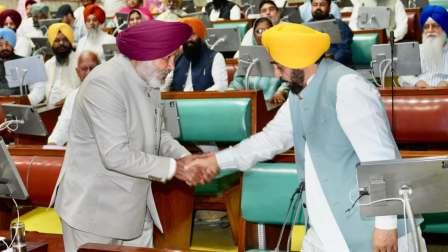
CHANDIGARH: Punjab Finance Minister Harpal Singh Cheema on Sunday presented the fifth Budget of the Aam Aadmi Party-led (AAP) government in Punjab for 2026–27, proposing a total outlay of ₹2,60,437 crore and projecting the state’s GSDP at ₹9,80,635 crore with an estimated growth rate of 10 per cent. Punjab Budget Tabled on International Women’s Day, the Budget unveiled the ‘Mukh Mantri Mawan Dhian Satikar Yojna’—a universal cash transfer scheme under which women will receive ₹1,000 per month and Dalit women ₹1,500—while outlining major allocations across education, healthcare, agriculture, infrastructure and social welfare, which the government described as fulfilling the all key electoral guarantees of Arvind Kejriwal and Bhagwant Mann.
Presenting the Punjab Budget , the Finance Minister said, “The Effective Revenue Deficit is projected at 2.06 per cent of GSDP and the Fiscal Deficit at 4.08 per cent.” He described the document as the “Saari Guarantiyan Puri Karan Wala Budget”, emphasising that the government has worked to fulfil all the guarantees made to the people.
Punjab Budget : Women to receive ₹1,000 per month, women from SC communities to get ₹1,500 every month
Presented on International Women’s Day, the Budget introduced the “Mukh Mantri Mawan Dhian Satikar Yojna”, which the Finance Minister described as the first universal cash transfer initiative for women. Explaining the scheme, Harpal Singh Cheema said, “Under this initiative, the government will transfer ₹1,000 per month directly to the accounts of all eligible adult women and ₹1,500 per month to adult women belonging to the Scheduled Caste community.” He added that a budgetary outlay of ₹9,300 crore has been earmarked to ensure that nearly 97 per cent of adult women in Punjab are covered, including women already receiving social security pensions.
The Finance Minister further said that the government has allocated ₹600 crore to continue the free bus travel facility for women, ₹932 crore for the Integrated Child Development Services (ICDS) covering more than 27,000 Anganwadi Centres, and ₹65 crore for the Navi Disha Scheme to provide free sanitary pads to needy women and adolescent girls.
Punjab Budget : Sikhiya Kranti 2.0’: ₹19,279 crore allocated to revolutionize education
Speaking about the education sector, Harpal Singh Cheema shared that the government has proposed an outlay of ₹19,279 crore, representing a seven per cent increase over the previous year. Highlighting reforms in the sector, he said, “Punjab’s top ranking in the national PARAKH assessment reflects the impact of reforms introduced in recent years.” The Finance Minister announced the launch of the “Sikhiya Kranti 2.0” initiative, a ₹3,500 crore project in collaboration with the World Bank aimed at transforming the education ecosystem.
Detailing the proposals, Harpal Singh Cheema said the Budget includes extensive infrastructure upgrades in schools, including boundary walls, toilets, security personnel and a large-scale whitewashing drive. ₹395 crore has been allocated for digital transformation in schools through the provision of computers and interactive panels. The successful Schools of Eminence model will be strengthened further, and a statewide career counselling framework will be implemented for more than 7.35 lakh students.
Punjab Budget : ₹569 crore has been earmarked for Technical Education
Turning to higher education, the Punjab Finance Minister added that ₹1,760 crore has been allocated as grant-in-aid to state universities, while ₹569 crore has been earmarked for Technical Education, including the establishment of ITIs in 11 jails to provide vocational training to inmates. The AAP government has granted in-principle approval for establishing a world-class university at Sri Anandpur Sahib in the name of Sri Guru Tegh Bahadur Ji.
Turning to healthcare, Harpal Singh Cheema said the government has proposed an allocation of ₹6,879 crore for the sector. He said, “The Mukhya Mantri Sehat Yojana has been provided a ₹2,000 crore provision to offer cashless treatment of up to ₹10 lakh per year for 65 lakh families in the state. The Aam Aadmi Clinics network, currently consisting of 881 clinics, will be expanded with the addition of 143 new clinics and the upgrading of 308 Subsidiary Health Centres, increasing the total to 1,432 clinics.”
The Punjab Budget also includes ₹300 crore for advanced medical equipment in government hospitals and provisions for establishing a modern Trauma Centre and Mother and Child Care Hospital at Sri Anandpur Sahib, along with an on-call incentive for specialist doctors.
The Finance Minister added that ₹1,220 crore has been earmarked for Medical Education and Research. He pointed to developments such as successful liver transplants at the Punjab Institute of Liver and Biliary Sciences in Mohali, the establishment of seven new medical colleges and the purchase of land for a new medical college in Malerkotla.
15,377 crore for Agriculture & Allied Sectors
Addressing the agrarian sector, Harpal Singh Cheema shared that ₹15,377 crore has been allocated for agriculture and allied sectors. He explained that the allocation includes ₹7,715 crore for free power to farmers. There is also a 33 per cent subsidy on Bt cotton seeds. Additionally, there are incentives for Direct Seeded Rice (DSR) and kharif maize. Furthermore, ₹600 crore is allocated for machinery to manage crop residue burning. He also announced a ₹1,300 crore project. It is supported by the Japan International Cooperation Agency (JICA). The project aims to expand horticulture acreage by 300 per cent by 2035.
He added that dairy farmers will be supported with a ₹100 crore provision for fair milk procurement prices. Sugarcane farmers will benefit from a ₹270 crore allocation. This follows the increase in the State Agreed Price to ₹416 per quintal.
Speaking about environmental sustainability, the Punjab Finance Minister said ₹238 crore has been allocated for forestry. This is under the Punjab Compensatory Afforestation Management and Planning Authority programme. A ₹760 crore JICA-supported biodiversity conservation project will also be implemented.
7,606 crore for Rural Roads & ₹7,257 crore for Urban Development,
On rural development, Harpal Singh Cheema said the Budget proposes ₹7,606 crore. This is to complete the modernisation of 19,876 kilometres of rural link roads. He mentioned that the AAP government has allocated ₹1,500 crore. This amount is for the Mahatma Gandhi National Rural Employment Guarantee Act (MGNREGA) scheme. The scheme is significant for rural development. Additionally, ₹800 crore has been allocated to construct one lakh houses under the Pradhan Mantri Awas Yojana (Gramin). The allocation for the Rangla Punjab Vikas Scheme has been doubled to ₹1,170 crore. This increase aims to ensure equitable development across all 117 constituencies.
Turning to urban development, the Punjab minister said the Municipal Development Fund has been increased fourfold to ₹1,000 crore. ₹500 crore has been proposed for the canal-based surface water supply project in Ludhiana and Amritsar. Additionally, ₹665 crore is allocated for AMRUT 2.0 projects. “In total, ₹7,257 crore has been proposed for the Housing and Urban Development sector,” he said.
2,805 crore for Industry following historic ₹55,000 crore investments
The Finance Minister also spoke about industrial growth under the Industrial Policy 2026. He said Punjab received ₹55,000 crore in investments in 2025 alone. This amount doubled foreign direct investment. It also raised the state’s national ranking in FDI inflows to 11th place. The Budget includes ₹500 crore for fiscal incentives and provisions for One Time Settlement (OTS) schemes.
Highlighting employment generation, Harpal Singh Cheema shared that 63,943 candidates have been recruited in government departments since 2022. ₹287 crore has been allocated for employment generation initiatives, including the operationalisation of new Armed Forces Preparatory Institutes.
Addressing internal security, he said an allocation of ₹11,577 crore has been proposed for Home Affairs, Justice and Jails. The “Yudh Nashian De Virudh” campaign will be strengthened through mobilisation of Village Defence Committees. Border surveillance will be enhanced with 2,367 CCTV cameras. A ₹100 crore outlay is planned for a comprehensive drug and socio-economic census. The Anti-Gangster Task Force will continue its operations. Emergency response systems such as the Sadak Surakhya Force and Dial 112 have been strengthened. ₹535 crore has been allocated for modernising jail security through AI-based surveillance and jammer systems.
Speaking about youth engagement, Harpal Singh Cheema said, “The government is investing ₹1,791 crore in sports infrastructure. It plans to build 6,000 new village playgrounds. The initiative will also establish 5,000 indoor gyms and organise adventure sports camps.”
AAP government released ₹1,010 crore for flood relief
The Finance Minister said the government will observe the 650th Prakash Diwas of Sri Guru Ravidas Ji. The celebration will be at the state level. The event will receive a ₹100 crore allocation. He also announced that a heritage-style Administrative Complex will be constructed at Sri Anandpur Sahib. This construction aims to commemorate the 350th Shaheedi Diwas of Sahib Sri Guru Tegh Bahadur Ji. ₹312 crore has been provisioned for the Mukh Mantri Tirath Yatra Scheme to facilitate pilgrimages for nearly 7.15 lakh citizens.
He also highlighted improvements in citizen services. He noted that doorstep delivery of 412 services has been implemented. Transport services have been digitised at Sewa Kendras. Digital land record platforms such as Easy Jamabandi and Easy Registry have also been introduced. The AAP government released ₹1,010 crore for flood relief through a fully digital system.
public buildings has been doubled to ₹5,440 crore.
Harpal Singh Cheema highlighted infrastructure investments. He added the allocation for roads, bridges, and public buildings has been doubled to ₹5,440 crore. This covers projects under Plan Roads, PMGSY-III, and the Central Road and Infrastructure Fund. ₹2,971 crore has been allocated for water resources. This funding aims to optimise canal networks. The government is working to double canal irrigation capacity to seven million acres by the end of the year. Flood protection works, drain cleaning, and strengthening of the Ferozepur Feeder and Kathgarh Lift Scheme are underway.
The Finance Minister highlighted the “Mission Roshan Punjab” initiative in the power sector. It includes a ₹5,000 crore investment. This aims to modernise the electricity distribution network with new substations. It will also cover 25,000 kilometres of power lines. He said reforms are also planned to reduce the state’s subsidy burden by 25 per cent without affecting consumer benefits. Civil aviation infrastructure has expanded with the operationalisation of the Adampur and Halwara airports.
Social Welfare and Justice sector has received an allocation of ₹18,304 crore.
He added that Punjab has achieved the top rank in the national Mining Readiness Index. Furthermore, mining revenue has doubled to over ₹500 crore. The transport sector will also witness expansion with the addition of 1,279 new buses.
Addressing food security and social welfare, Harpal Singh Cheema said the government has introduced the “Meri Rasoi” scheme. The scheme includes a ₹900 crore allocation to provide free quarterly essential ration kits. Nearly 40 lakh families will benefit from this initiative. He added that new ration card enrolments will be opened for 10 lakh additional beneficiaries. Employment opportunities will also be generated through the allotment of nearly 7,500 Fair Price Shops.
He shared that the Social Welfare and Justice sector has received an allocation of ₹18,304 crore. This includes ₹6,150 crore for monthly financial assistance pensions. Additionally, ₹17,700 crore is earmarked under the Scheduled Caste Sub-Plan.
Concluding his Budget speech, the Punjab Finance Minister said total revenue receipts are projected at ₹1,26,190 crore. This will be supported by increased devolution from the 16th Finance Commission. It will bring ₹30,464 crore in central taxes to the state. He added that governance reforms have improved excise revenue projections. Enforcement has also contributed to projecting revenues of ₹53,122 crore over the government’s five-year tenure. The state has set a target of ₹9,000 crore from stamps and registration. Additionally, ₹32,000 crore is targeted from GST for the financial year 2026–27.
The Finance Minister also said the state has injected ₹1,000 crore into the Guarantee Redemption Fund. They have doubled capital expenditure to ₹18,381 crore for asset creation. “The Debt-to-GSDP ratio has been reduced from 48.25 per cent to 44.47 per cent,” Harpal Singh Cheema said, adding that the government remains committed to strengthening the financial health of Punjab while investing in infrastructure and public welfare.




Leave a Reply